EV Home Charging Calculator
Calculate the cost, electrical requirements, and charging time for installing a home charging station for your electric vehicle.
List of the Best EV Chargers:


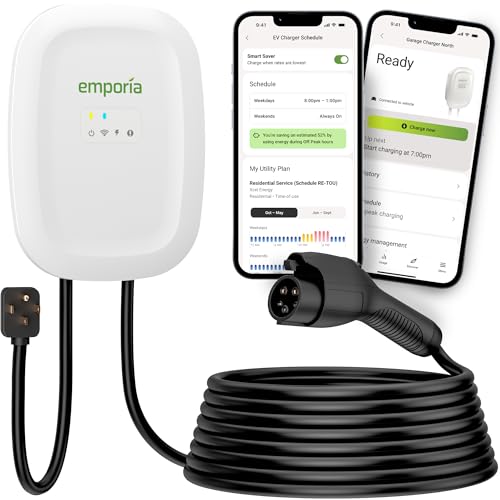


Comprehensive Guide to EV Home Charging
Home charging represents the most convenient and cost-effective method for keeping your electric vehicle powered. Unlike public charging stations that can be expensive and sometimes unreliable, home charging allows you to start each day with a "full tank" at a fraction of the cost of gasoline. This comprehensive guide covers everything you need to know about setting up, optimizing, and benefiting from a home charging system for your electric vehicle.
Level 1 vs. Level 2 Charging: Understanding the Basics
Home charging comes in two primary forms: Level 1 and Level 2. Level 1 charging uses a standard 120-volt household outlet and provides 2-5 miles of range per hour of charging. This method requires no special installation but is only sufficient for drivers with short daily commutes (under 40 miles) who can charge overnight for 12+ hours. Level 2 charging uses a 240-volt circuit (similar to what powers an electric dryer or oven) and provides 10-60 miles of range per hour, making it suitable for nearly all EV owners regardless of daily mileage.
The Economics of Home Charging Installation
The cost of installing a home charging station varies significantly based on several factors. A basic Level 2 installation with the electrical panel in the garage and minimal wiring might cost $500-$800. More complex installations requiring panel upgrades, long wire runs, or trenching can range from $1,500 to $5,000. Many utility companies and state governments offer rebates that can cover 50-100% of installation costs. The federal government also provides a tax credit covering 30% of installation costs up to $1,000. When considering these incentives, many homeowners find the net cost to be minimal or even zero.
Electrical Requirements and Panel Capacity
Before installing a Level 2 charger, an electrician must assess your home's electrical capacity. Most modern homes have 100-200 amp service, which is typically sufficient for adding a 240-volt circuit. The charger itself will require a dedicated circuit of 20-60 amps, with 40-amp circuits being most common for residential installations. Older homes with 60-amp service may require a panel upgrade. Smart load management devices can also be installed to prevent overloading the panel by temporarily reducing charging power when other high-demand appliances are in use.
Charging Equipment: Mobile Connectors vs. Wall Units
Most EVs come with a mobile charging cable that can plug into both 120V and 240V outlets (with the proper adapter). These are convenient but less durable than dedicated wall-mounted units. Wall-mounted Level 2 chargers typically offer faster charging speeds (up to 48 amps vs. 32 amps for most mobile connectors), better weather resistance for outdoor installations, and additional features like scheduling, power monitoring, and Wi-Fi connectivity. Prices for wall-mounted chargers range from $400 to $800, with premium models offering smart features and higher power output.
Charging Speed and Time Calculations
Charging speed depends on both the charger's power output and the vehicle's onboard charger capacity. Most EVs have onboard chargers capable of accepting 32-48 amps at 240V. The formula for calculating charging time is simple: Battery Capacity (kWh) ÷ Charger Power (kW) = Hours to Full Charge. For example, a 75 kWh battery charging at 7.7 kW (32 amps × 240V ÷ 1000) would take approximately 9.7 hours to charge from empty to full. In practice, most drivers only need to replace their daily usage, which typically takes 2-4 hours on a Level 2 charger.
Time-of-Use Rates and Smart Charging Benefits
Many utility companies offer special time-of-use (TOU) rates for EV owners, with electricity prices significantly lower during off-peak hours (typically 9 PM to 6 AM). These rates can be as low as $0.05-0.08/kWh compared to standard rates of $0.15-0.25/kWh. Smart chargers can be programmed to charge only during these off-peak hours, potentially cutting charging costs by 50-70%. Some advanced systems can even integrate with home solar panels, prioritizing charging when solar production is highest.
Safety Considerations and Best Practices
Home charging systems are extremely safe when installed properly by a licensed electrician. Key safety features include Ground Fault Circuit Interrupter (GFCI) protection, weatherproof enclosures for outdoor installations, and proper circuit breaker sizing. It's also important to use only charging equipment that's been certified by recognized testing laboratories (UL, ETL, etc.). Regular inspection of charging cables for damage and keeping connectors clean and dry are essential maintenance practices.
Multi-EV Household Considerations
Households with multiple EVs have several options for charging. The simplest approach is to install two separate Level 2 chargers on separate circuits. A more cost-effective solution is a dual-head charger that shares power between two vehicles. Smart power management systems can also be installed to divide available power between multiple chargers without overloading the electrical panel. Some families find that one Level 2 charger combined with Level 1 charging for the second vehicle is sufficient, especially if driving patterns differ between vehicles.
Renter and Condo Owner Solutions
Renters and condo owners face additional challenges for home charging but have several options. Renters can negotiate with landlords to install a charger, sometimes offering to pay for the installation or split costs. Many states have "right to charge" laws that prevent landlords from unreasonably denying installation requests. Condo owners can work with their homeowner associations to install chargers in assigned parking spots. Portable Level 2 chargers that can be plugged into existing 240V outlets (like dryer outlets) are another temporary solution.
Battery Health and Charging Optimization
Proper charging habits can significantly extend your EV battery's life. Most manufacturers recommend setting the daily charge limit to 80-90% to reduce stress on the battery. Charging to 100% should be reserved for trips when the extra range is needed. It's also beneficial to avoid letting the battery sit at very low states of charge for extended periods. Many EVs allow you to schedule charging to complete just before departure, which ensures the battery isn't held at high charge levels for longer than necessary.
Cost Comparison: Home Charging vs. Public Charging
Home charging is almost always significantly cheaper than public charging. At average US electricity rates of $0.15/kWh, home charging costs about $0.043 per mile for a vehicle achieving 3.5 mi/kWh. Public Level 2 charging typically costs $0.20-0.40/kWh ($0.057-0.114 per mile), while DC fast charging costs $0.30-0.60/kWh ($0.086-0.171 per mile). Over 15,000 miles annually, this translates to savings of $645-$1,815 compared to public Level 2 charging and $1,290-$3,630 compared to DC fast charging.
Integration with Solar Power Systems
Home solar panel systems can provide virtually free charging for your EV. The typical home solar system produces 10-20 kWh per day, which is sufficient to charge most EVs for 30-60 miles of daily driving. Smart charging systems can be programmed to charge primarily when solar production is highest, maximizing self-consumption of solar energy. Some utilities offer special programs that credit solar producers at higher rates, making solar-charged EVs even more economical.
Future-Proofing Your Installation
When installing a home charging system, consider future needs. Installing a higher-capacity circuit (60 amps) than currently needed allows for faster charging with future EVs. Choosing a smart charger with Wi-Fi connectivity ensures compatibility with future utility programs and software updates. Installing conduit rather than direct-burial cable makes future upgrades easier. Considering potential future solar or battery storage integration during the initial installation can also save money in the long run.
Maintenance and Long-Term Costs
Home charging equipment requires minimal maintenance. The charging cable should be inspected periodically for damage, and the connector should be kept clean. Most wall-mounted chargers are rated for 10+ years of operation. The primary long-term cost is electricity, which typically amounts to $300-$600 annually for average driving. Compared to gasoline costs of $1,500-$2,500 annually for a similar vehicle, the savings are substantial even after accounting for the initial installation investment.
Frequently Asked Questions
How much does it cost to install a home EV charger?
Installation costs range from $500 for a simple installation with the electrical panel in the garage to $3,000+ for complex installations requiring panel upgrades or long wire runs. The charger equipment itself costs $400-$800. Many utilities and governments offer rebates that can cover 50-100% of these costs.
Can I use a regular outlet to charge my EV?
Yes, Level 1 charging uses a standard 120V outlet and provides 2-5 miles of range per hour. This is sufficient for many drivers who commute less than 40 miles daily and can charge overnight for 12+ hours. However, Level 2 charging is recommended for most EV owners for faster charging and greater flexibility.
Do I need a special circuit for EV charging?
For Level 2 charging, yes. You need a dedicated 240-volt circuit similar to what powers an electric dryer or oven. The circuit should be installed by a licensed electrician and typically requires a 20-60 amp breaker depending on your charger's specifications.
How long does it take to charge an EV at home?
With Level 2 charging, most EVs can fully charge overnight in 6-10 hours. In practice, you're typically only replacing your daily driving, which usually takes 2-4 hours. Level 1 charging is much slower, adding only 30-50 miles of range over 12 hours.
Will charging my EV at home increase my electricity bill significantly?
For the average driver covering 12,000 miles annually, home charging adds $30-$50 to the monthly electricity bill. This is significantly less than the $100-$200 monthly cost of gasoline for a comparable vehicle.
Can I install an EV charger myself?
While it's technically possible for experienced individuals, it's strongly recommended to hire a licensed electrician. Improper installation can create fire hazards, void your homeowner's insurance, and potentially damage your vehicle. Many rebate programs also require professional installation.
What's the difference between 16 amp, 32 amp, and 48 amp chargers?
These numbers refer to the maximum current the charger can provide. A 16-amp charger provides about 3.8 kW (16A × 240V), adding 12-15 miles per hour. A 32-amp charger provides 7.7 kW, adding 25-30 miles per hour. A 48-amp charger provides 11.5 kW, adding 35-45 miles per hour. Most homes can support 32-amp chargers, while 48-amp installations may require electrical panel upgrades.
Do I need a smart charger?
Smart chargers offer advantages like scheduling charging during off-peak hours, tracking energy usage, and receiving software updates. They're particularly valuable if your utility offers time-of-use rates. Basic "dumb" chargers are less expensive and perfectly functional if you don't need these features.
Can I charge my EV in the rain?
Yes, EV charging equipment is designed to be weather-resistant and safe for outdoor use. Both the vehicle charging port and charging connectors have protective covers and are rated for wet conditions. However, it's still good practice to keep connectors as dry as possible and avoid handling them with wet hands.
How do I get rebates for EV charger installation?
Check with your local utility company and state energy office for available rebates. The federal tax credit (30% up to $1,000) is claimed on your annual tax return. Some programs require pre-approval before installation, so research available incentives before beginning your project.